
Press Release: Publication of the DIHAC Study on Thai Older Persons’ Digital Capacity and Application of Technology for Healthy Aging: A Mixed-Method Study
New Research Article from DIHAC study
Nov 29, 2025 As the world is rapidly transforming into digital society, it is important to ensure that older adults are getting full benefit from the internet and digital technology. A recent article from the DIHAC study titled “Thai Older Persons’ Digital Capacity and Application of Technology for Healthy Aging: A Mixed-Method Study” published on the Journal of Aging Research has revealed that older adults with higher level of digital skills are more likely to apply digital technology for health promotion, leading to healthy ageing. The study reported the evidence of digital inclusion towards healthy ageing among the older persons in the most aged society in South East Asia: Thailand.
This study is part of the ongoing study “Digitally Inclusive, Healthy Ageing Communities (DIHAC): A Cross-Cultural Study in Japan, Republic of Korea, Singapore, and Thailand”, funded by the Japanese Ministry of Education, Culture, Sports, Science and Technology, Grant-in-Aid for Scientific Research [grant numbers 21H00795, 23K20657]. The DIHAC study is led by Principal Investigator Associate Professor Myo Nyein Aung. DIHAC team is a collaboration of Chiang Mai Rajabhat University, Thailand, Yonsei University, ROK, Singapore University of Social Sciences, Singapore, and Juntendo University, Japan. Furthermore, Emeritus Professor Jan A.G.M. van Dijk co-authored this paper. The first author Thet Htoo Pan is affiliated to the Department of Global Health Research, Juntendo University, Tokyo Japan as PhD candidate.
This research was motivated by the growing concern that the digital divide could worsen existing health disparities among the ageing population. The population of Thailand, an aged society and a middle-income economy, is at risk of “growing old before it grows rich”. Meanwhile, it is becoming more and more digitalized, especially in the context of health and social care delivery. Therefore, promoting healthy aging through digital inclusion is timely and necessary. The study, conducted by the DIHAC study researchers, aimed to measure the digital skills of older adults and assess the pathway towards inclusive future for ageing society.
Grounded on the digital divide theory, this mixed-method study identified five types of digital skills belonging to the Thai older adults: ‘operational internet skills’, ‘information navigation skills’, ‘social skills’, ‘creative skills’, and ‘mobile skills’; and examined their association with various health outcomes. Qualitatively we identified the pathways for using the internet towards healthy ageing in the context of Thailand. Enhanced ‘social skills’ boost self-rated health, while ‘information navigation skills’ improve access to healthcare. Older adults with higher levels of ‘operational skills’ and ‘social skills’ positively associated with application of technology for health promotion. Multiple focus-group interviews of older persons revealed how smart phone apps enabled them to stay connected, seek care and help others. Policy recommendations emphasize promoting digital literacy among older adults in the community for active and healthy ageing.
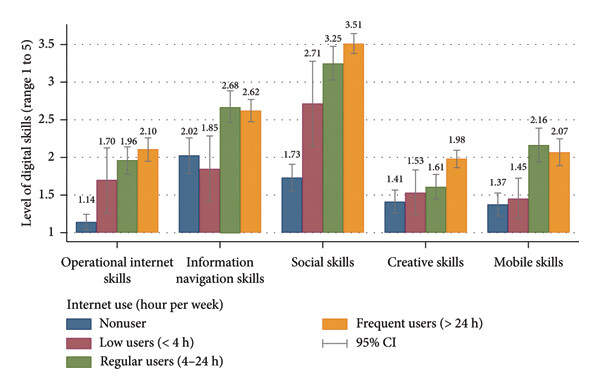
Figure. Distribution of five types of digital skills across time spent on internet among community older adults in Thailand (N = 500). Pan et al. (2025)/ Journal of Aging Research/ DOI: https://onlinelibrary.wiley.com/doi/10.1155/jare/8080561
To address the challenges of grey digital divide, the study advocates for the implementation of digital literacy training programs tailored for older adults. Such programs could empower older people to access vital health information, stay connected with loved ones, and participate more fully in society. The research team believes that by empowering the digital inclusion of older adults, health outcomes for older adults can be improved and foster greater social inclusion.
The implications of this research are far-reaching, with the aim to advocate public health policies and inspire similar studies in other countries facing the challenges of an ageing population and digital gap. By addressing the digital inclusion among older adults, the DIHAC study can set a precedent for how nations and communities can support their ageing populations in the digital era.
For more information, please read the full article here.
The authors would like to thank all those involved for working together.
Reference
| Authors | Thet Htoo Pan 1, Myo Nyein Aung 1,2,3,*,Saiyud Moolphate 4, Thin Nyein Nyein Aung 5,6, Yuka Koyanagi 7, Carol Ma Hok Ka8, Eun Woo Nam9, Jan A.G.M. van Dijk 10 and Motoyuki Yuasa 1,2 |
| Title of original research article | Thai Older Persons’ Digital Capacity and Application of Technology for Healthy Aging: A Mixed-Method Study |
| Journal | Journal of Aging Research |
| DOI | https://onlinelibrary.wiley.com/doi/10.1155/jare/8080561 |
| Affiliations | 1Department of Global Health Research, Graduate School of Medicine, Juntendo University, Tokyo 113-8421, Japan 2Faculty of International Liberal Arts, Juntendo University, Tokyo 113-8421, Japan 3Advanced Research Institute for Health Sciences, Juntendo University, Tokyo 113-8421, Japan 4Department of Public Health, Faculty of Science and Technology, Chiang Mai Rajabhat University, Chiang MaimThailand 5Department of Family Medicine, Faculty of Medicine, Chiang Mai University, Chiang Mai, Thailand 6Global Health and Chronic Conditions Research Group, Chiang Mai University, Chiang Mai, Thailand; 7Department of Judo Therapy, Faculty of Health Sciences, Tokyo Ariake University of Medical and Health Sciences, Tokyo 135-0063, Japan 8S R Nathan School of Human Development, Singapore University of Social Sciences, Singapore 599494, Singapore 9Ⅾepartment of Health Administration, Software Digital Healthcare Convergence College, Yonsei University, Wonju City, 26493, Republic of Korea 10Department of Communication Science, University of Twente, Enschede, 7500 AE, The Netherlands *Correspondence: Myo Nyein Aung, Principal investigator, DIHAC study |
About DIHAC study
Digitally Inclusive, Healthy Ageing Communities (DIHAC) is a cross-cultural study primarily based on Japan, the Republic of Korea, Singapore, and Thailand, further expanding to India, Malaysia, Vietnam, Europe and Latin America. The study aims to explain the contextual influences of digital inclusion and its consequences on healthy ageing in the digital era.
This research was funded by the Japanese Ministry of Education, Culture, Sports, Science and Technology, Grant-in-Aid for Scientific Research 21H00795 and 23K20657. The authors declare no COI.