
33rd DIHAC cross-cultural exchange meeting analysis report
Two Asian Pathways to Digital Inclusion: Indonesia’s National Health Screening App and Japan’s Community-Based Digital Skills Scale-up Training
Thet Htoo Pan, Myat Yadana Kyaw, Imran Pambudi, Tomohiko Ueno, Myo Nyein Aung, and Paul Ong.
Report in Japanese Report in Thai Report in Spanish Report in Vietnamese Report in Korean
The Digitally Inclusive Healthy Ageing Communities (DIHAC) is a cross-cultural study primarily based on Japan, Republic of Korea, Singapore and Thailand, further expanding to India, Malaysia, Vietnam and other Europe and Latin American countries through collaboration. We organize bi-monthly cross-cultural exchange meetings to create trans-disciplinary learning opportunities. The DIHAC meeting marks its 33rd time on 23 February 2026. The 33rd DIHAC meeting highlighted digitally inclusive healthy ageing innovations from Indonesia and Japan.
Principle investigator of the DIHAC study, Associate Professor Myo Nyein Aung, Department of Global Health Research, Juntendo University, Japan started the meeting and socialized with the participants. More than 70 participants included researchers in global health and public health, faculties from universities, clinicians, government officials: members from Active Aging Consortium in Asia Pacific (ACAP), ASEAN Centre for Active Ageing and Innovation (ACAI), HelpAge representatives, community stakeholders, representatives from INGOs and graduate and undergraduate students from Japan, Republic of Korea, Singapore, Thailand, Vietnam, Cambodia, Malaysia, Indonesia, Philippines, China, Nepal, India, Italy, Netherlands, Belgium, South Africa, Ukraine, actively participated in the meeting. Dr Myo noted that this session attracted the largest number of participants in DIHAC history.
We are honoured to have Dr Paul Ong, Deputy Chief Executive Officer and Chief Strategy Officer of the Tsao Foundation in Singapore, to chair the 33rd DIHAC meeting. In his opening remarks, Dr Ong highlighted those digital technologies, such as smartphones and tablets, have become central to daily life, access to services and social support. Many countries across Asia moved rapidly from limited landlines to widespread mobile connectivity, yet older adults often remain the last to benefit. The COVID-19 pandemic showed that, with support, older people can adopt digital tools. Dr Ong noted how his own parents quickly learned to use tablets despite risks such as online scams. This 33rd DIHAC meeting showcases two responses to these challenges: Indonesia’s national digital health screening system and Japan’s community-based digital skills training. Both are examples of how technology can empower older people when human support remains at the core.
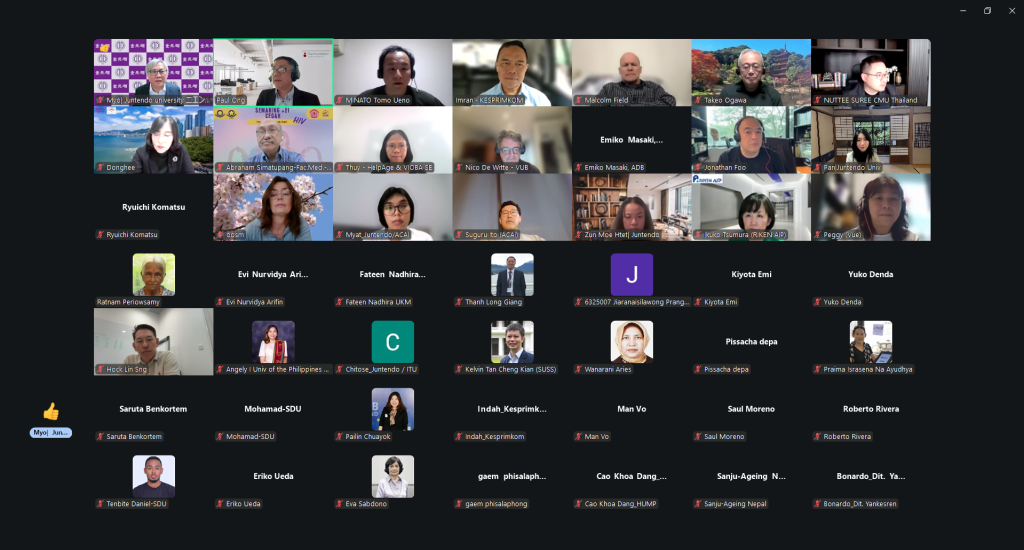
Figure: Chairperson Dr Paul Ong, speakers, international audience and DIHAC study team at the 33rd DIHAC meeting on February 23rd, 2026
Presentation 1: Health screening application developed and implemented by Ministry of Health, Indonesia
The first presentation was delivered by Mr. Shintaro Nakayama, Chief Operating Officer of OUI Inc. and Researcher at the Department of Ophthalmology, Keio University School of Medicine, Tokyo. His presentation addressed the growing global burden of blindness and visual impairment, noting that over one billion people worldwide experience vision loss, much of which is preventable or treatable with early diagnosis (1). Mr. Nakayama introduced the Smart Eye Camera (SEC), an innovative digital health solution that transforms a smartphone into a portable slit-lamp microscope through a specialized medical attachment. The smartphone’s built-in flashlight functions as a light source, while a dedicated application enables high-quality image capture, secure cloud storage, and real-time data sharing. This allows eye images to be reviewed remotely by specialists, supporting tele-ophthalmology services in settings with limited access to trained ophthalmologists.
The first speaker was Dr Imran Pambudi, MD, MPHM, Director of Vulnerable Group Health Services at the Ministry of Health in Indonesia. Dr Pambudi presented the Cek Kesehatan Gratis (CKG) Free Health Checkup Programme [1]. Launched in February 2025, the program applies a life-cycle approach, offering screening for newborns (2 days old), toddlers and preschoolers (age 1-6), adults (ages 18-59) and older people (60 years and above). Progress accelerated between August and December 2025. Over 72 million Indonesians have now been screened, including 47 million at community health centres (Puskesmas) and 25 million schoolchildren, across all 38 provinces and over 10,000 (Puskesmas). In addition, more than 6 million older people (35.5%) have been screened out of the target 16.9 million.
Three tiers of screening packages: minimum, medium and comprehensive packages tailor to different needs. FAST package (minimum) covers common health screening such as physical activities, mobility, blood pressure and blood sugar and comprehensive (GREAT) package cover as many as 20 items for older adults. As the country is experiencing a rapid demographic transition towards population over 60 reaching up to 11.9%, an integrated geriatric and functional screening package support healthy ageing [2]. Common health issues identified among older persons include low physical activity, mobility limitations, missing teeth, and hypertension (35%), as well as other NCD risk factors.
To ensure inclusive digital access, Indonesia uses a multi-channel registration system: the SatuSehat mobile app, a WhatsApp chatbot, widely used by older adults, and on-site assisted registration at local health centres. Even though only 4.7% of older Indonesians are active internet users, around 6% of older participants in the screening programme registered through the app, often with the help of younger family members. Standardized procedures Puskesmas and integrated electronic reporting system support continuity of care, with accessible interfaces for older adults. In addition, community-based screening, such as community health posts (Posyandu) or mosques during Ramadan extended reach. Dr Pambudi emphasized the need for ongoing capacity building, strengthened outreach and follow-ups informed by centralized data linkage across healthcare facilities nationwide. Discussion points included coverage of older people despite low internet usage, specificity of screening tools, data security management and interoperability, and integration into the national health system.
- Indonesia’s national digital health screening system has reached over 72 million people, exemplifying the large-scale implementation of digital public health promotion.
- Digital inclusion often occurs across generations, with younger family members supporting older adults.
- Multi-channel registration (combination of offline-online) and community-based outreach help engage older adults with limited digital access.
Presentation 2: Scaling up the digital literacy and skills of older persons in Minato city, Tokyo, Japan
The second speaker, Mr Tomoiko Ueno from the Minato City Social Welfare Council in Japan, shared a community-driven model that helps older people acquire digital literacy through the ‘Smartphone/Tablet Meisters’ volunteer program. Firstly, Mr. Ueno debriefed the context of vibrant, internationalized urban Minto City, hosting 19.4% of its total population as older people, many at risk of being left behind by digitalisation.[3].
Minato City promotes digital services through official LINE account, and Minato Pay, a local digital currency designed to promote local economies. He also explained the social welfare council in Japan which is a unique feature system in every municipality coordinating community activities across volunteers and non-profit organizations (NPO).
Digital literacy training for older adults began during the pandemic to maintain social participation and cognitive health. As digital transformation accelerated, the social welfare council, expanded digital literacy program by training “Smartphone/ Tablet meisters” to teach digital skills to older residents. As of February 2026, 42 volunteers of different ages, including many older adults, have been trained, which create a peer-to-peer support model. The volunteers meet learners in familiar community settings, such as homes, supermarkets and community centres, so that they feel at ease when learning to use digital tools. The training offers personalised, step-by-step instruction, emphasises patience, repetition, and confidence-building, rather than technical complexity. Volunteers receive star-marked badges as motivation and recognition.
This community outreach model works at scale-up because it is built on trust and warm interpersonal relationships. Notably, older men participate more actively as digital volunteers than in other community activities, gaining s sense of self-efficacy. Whereas learners (mainly women) value the one-to-one guidance. Beyond digital skills, the programme strengthens social connections and promotes broader community participation. The speaker emphasised that ‘the goal is not to technical mastery, but helping older adults feel positive and empowered while using digital tools.
The discussion focused on digital inclusion as both a technological and social process. Participants offered cross-cultural reflections. A participant from HelpAge Vietnam noted alignment with intergenerational clubs nationwide and expressed interest in adapting the Smartphone Meister curriculum. Mr Tum from HelpAge Cambodia discussed the digital training showing clear benefits to older learners. Professor Park from ROK emphasized the need for age-friendly digital literacy frameworks; Ms Angely from University of the Philippines reflected on blending digital tools with existing social activities; and Professor Madelon van Oostrom, Prof. of Digital Inclusion from the Netherlands discussed training schedules and reward systems. The speaker concluded that rapid digitalisation risks deepening the digital divide, making it essential to design programmes that support older adults without overwhelming them.
- The volunteer-led Smartphone Meister programme in Minato City shows that community members can significantly promote digital inclusion among older adults, while strengthening social ties.
- Older adults learn effectively when training is patient, culturally sensitive and confidence-building.
- Peer-to-peer models build trust and mutual support among older adults, benefiting both volunteers and trainees.
Dr Paul Ong concluded the 33rd DIHAC meeting by emphasising the importance of human interaction amidst the rapid development of digital technologies. He noted that technology can bring older adults to engage with communities, for example, by encouraging them to visit health centres for screening, when it is paired with real-world social support. Blending digital tools with familiar community spaces create a more inclusive environment for healthy ageing. Dr Myo announced that the 34th DIHAC meeting will take place on 22 April 2026.
References
- Indonesia, Ministry of Health. Free Health Check: Better Health for All, , Health Development Policy Agency (BKPK Kemenkes). 2025 [cited 2026 24 February]; Available from: https://www.badankebijakan.kemkes.go.id/en/cek-kesehatan-gratis-kesehatan-yang-lebih-baik-untuk-semua/.
- ESCAP, U.N., United Nations Economic and Social Commission for Asia and the Pacific Population Data Sheet 2024. 2024.
- Tokyo Metropolitan Government, B.o.S.W.a.P.H. Data on Older People (Reiwa 6 Edition). 2024 [cited 2026 24 February]
Authors
Thet Htoo Pan, M.D., is Ph.D. student at the Department of Global Health Research, Graduate School of Medicine, Juntendo University, Tokyo, Japan
Myat Yadana Kyaw, M.D., is Ph.D. student at the Department of Global Health Research, Graduate School of Medicine, Juntendo University, Tokyo, Japan
Imran Pambudi, M.D., MPHM is Director of Vulnerable Group Health Services, Ministry of Health, Indonesia
Tomohiko Ueno, is community support coordinator and community social worker at Community Welfare Section, Minato City Council of Social Welfare, Tokyo, Japan
Myo Nyein Aung, M.D., M.Sc., Ph.D., is Associate Professor at the Department of Global Health Research, Graduate School of Medicine, Juntendo University, Tokyo, Japan
Paul Ong, Ph.D., is Deputy Chief Executive Officer and Chief Strategy Officer of the Tsao Foundation, Singapore